
SEO with Schema.org uses structured data (code) to help search engines better understand your content, leading to richer, more attractive search results (rich snippets) that boost visibility and click-through rates (CTR) for things like product prices, reviews, and FAQs, even if it doesn't directly impact rankings.
By implementing Schema.org markup, typically in JSON-LD format, you provide explicit context (e.g., a recipe's cook time, a product's availability) that search engines use to display enhanced results, giving your site a competitive edge.
If you need to improve the SEO of your web pages, it’s recommended to put in place structured data on your website.
What is Schema.org structured data?
Schema.org (also called schema) is a semantic vocabulary of tags that you can add to your HTML Pages to improve how search engines read and represent your page in SERPs.
JSON-LDFormat
JSON for Linking Data is a way to create a network of standards-based, machine-readable data across websites. It is a lightweight data format, easy for humans to read and write.
JSON-LDexample.Structured representation of the HTMLexample. Here's an example of WebSite structured data that includes the required fields:
<script type="application/ld+json">
    {
    "@context": "https://schema.org",
    "@type": "WebSite",
        "name": "Dervic Blog",
        "url": "https://dervic.blog"
        }
    </script>
The JSON-LD contains standard markups to describe the content of the article.
You can find all the markups at schema.org.
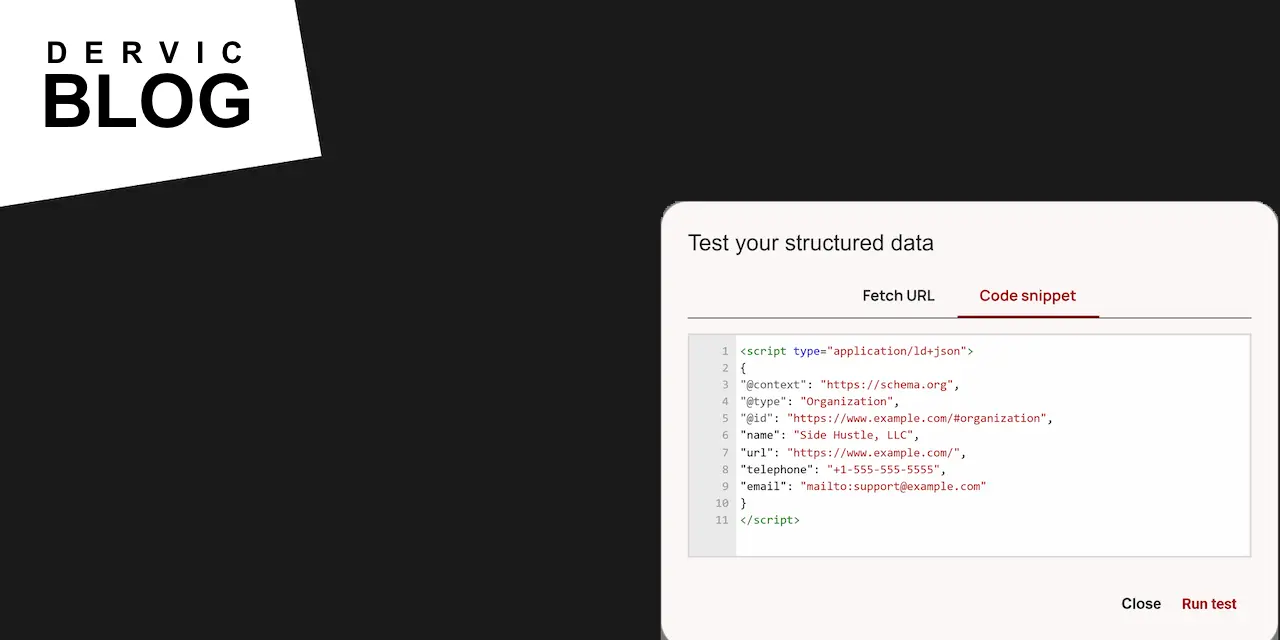
Paste the URL of your website, and test the URL. If the markup is correct, you’ll see a page like this.
Validate your page
To do so you can use two websites. The Schema Markup Validator and the Google Rich Results Test tool.
Conclusion
The Schema.org Markup is a way to help search engines and machines in general, to understand the type of content that your webpages include.
This helps you with SEO and SERP, and helps your websites to stand up from the crowd.
The WebSite structured data must be on the home page of the site. By home page, we mean the domain or subdomain level root URI. For example, https://example.com is the home page of the domain, while https://example.com/de/index.html isn't the home page.
Note: If there's no structured data on the subdomain's home page, then the domain-level site name may be used for the subdomain as a fallback.
Only one name per site
Note that subdomain names starting with www or m are generally considered as being equivalent.
-
Supported
→
https://example.com
(this is a domain-level home page) -
Supported
→
https://m.example.com
(this is also considered to be a domain-level home page) -
Not supported
→
https://example.com/news
(this is a subdirectory-level home page)
🐘 Congratulations, you’re now able the
Schema.orgof your website.
If you enjoyed this article, you may also like Dervic Blog.
Comments (0)